 Written by Feng Zhou
In professional trading, broker selection is not a marketing decision but a risk-management and performance variable. From a scientific and trading-systems perspective, a broker should be treated as part of the trading environment, comparable to volatility regimes, transaction costs, or liquidity conditions. An inappropriate broker choice can distort strategy expectancy, increase tail risk, and invalidate backtesting assumptions. Therefore, comparing forex brokers requires a structured, analytical methodology that prioritizes capital protection, execution quality, and total trading cost, rather than superficial features or promotional claims.
This section presents a professional, research-oriented framework for comparing forex brokers. It explains why comparative analysis is essential, defines absolute versus relative comparison criteria, analyzes the role of geography, and provides a detailed comparison table for FxPro, HFM, Exness, FXCC, and XM.
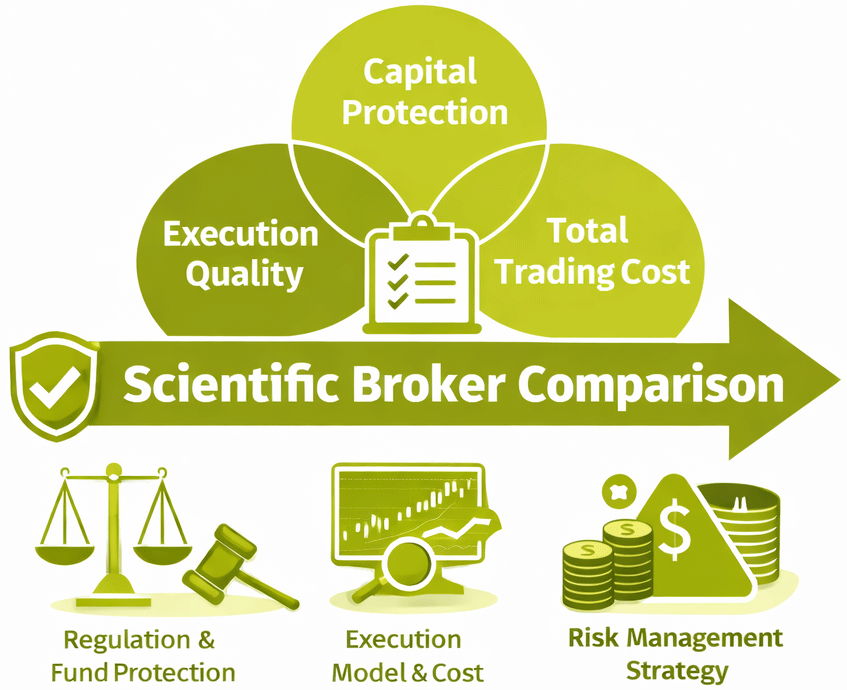
A comparative analysis of forex brokers is necessary because brokers directly influence three measurable components of trading performance: downside risk, cost efficiency, and execution stability. In quantitative terms, the expected value (EV) of a trading system is highly sensitive to transaction costs and execution variance. Even a profitable strategy with a positive expectancy can become unviable when implemented with a broker that introduces excessive spreads, asymmetric slippage, or unreliable order execution during high-impact events. From a risk-management perspective, brokers represent counterparty risk. Unlike exchange-traded instruments, retail forex trading is over-the-counter, meaning the trader’s funds and positions depend on the broker’s operational integrity, regulatory environment, and liquidity management. A scientifically minded trader must therefore assess broker failure risk in the same way portfolio managers assess credit risk. Comparative analysis is also essential because broker characteristics interact differently with trading styles. Scalpers and high-frequency traders are sensitive to latency, slippage distribution, and spread stability, while swing and position traders are more exposed to swap rates, rollover policies, and long-term fund safety. Without comparison, traders risk selecting a broker whose strengths do not align with their strategy’s statistical profile. Finally, comparative broker analysis improves decision rationality. It replaces cognitive biases induced by marketing, bonuses, or anecdotal reviews with structured criteria and measurable variables. In this sense, broker comparison is not optional; it is a prerequisite for maintaining methodological consistency between research, backtesting, and live execution.
The following fifteen criteria form a coherent analytical system. Some are absolute (non-negotiable), while others are relative and strategy-dependent. The first criteria define the non-negotiable foundation of broker comparison. Regulation and fund protection determine capital survivability, execution model determines structural fairness, and total cost determines long-term expectancy. If a broker fails at this level, further comparison becomes irrelevant, regardless of secondary features or promotional advantages.
1 – Regulation quality and legal entity mapping
A forex broker is not a single legal counterparty but a corporate structure composed of multiple legal entities operating under different jurisdictions. The trader’s actual counterparty is the specific legal entity with which the trading account is opened, not the brand name. Regulation defines the legal and financial environment in which trading occurs. It governs leverage caps, margin requirements, reporting obligations, negative balance protection, client fund segregation, and dispute resolution mechanisms. From a risk-management standpoint, regulation determines the maximum recoverable loss in non-market failure scenarios. A professional comparison begins by identifying the exact legal entity stated in the account agreement and onboarding documentation. Regulators should be assessed based on enforcement rigor, supervisory transparency, and historical intervention behavior rather than marketing reputation. Jurisdictions offering structured investor-protection frameworks impose constraints that reduce systemic risk but may limit leverage flexibility. Offshore jurisdictions often allow higher leverage but shift more risk to the trader. The comparison must therefore be explicit about the trade-off between regulatory protection and trading freedom.
2 – Client money protection: segregation, safeguarding, and insolvency posture
Client money protection refers to the legal and operational separation of client funds from the broker’s own capital, as well as the procedures governing fund treatment in the event of broker insolvency. This criterion addresses tail risk, not trading performance. A trader can correctly forecast market movements and still incur total loss if the broker fails operationally or financially. Client fund protection is therefore a prerequisite condition, not an optimization variable. The analysis should verify whether client funds are held in segregated accounts and whether segregation is enforced at the legal or merely operational level. It is also essential to understand the insolvency hierarchy: whether clients are treated as unsecured creditors or protected claimants. Compensation mechanisms, where applicable, further reduce non-market risk but should not substitute for segregation quality. Brokers that clearly document these mechanisms reduce uncertainty and model risk.
3 – Execution model and conflict-of-interest structure
The execution model defines how orders are processed, routed, and filled. This includes market execution versus instant execution, internalization practices, liquidity aggregation, and the presence or absence of dealing desk intervention.Execution quality directly affects realized trading results through spread behavior, slippage distribution, and order rejection probability. From a systems perspective, execution is part of the strategy’s implementation layer. Any conflict of interest between broker and client introduces structural bias into this layer. Preference should be given to transparent market execution models where prices are derived from aggregated liquidity and slippage—both positive and negative—is possible. Instant execution models with requotes or asymmetric slippage introduce execution uncertainty that is difficult to quantify. Professional evaluation requires empirical testing: executing small-volume live trades and statistically analyzing fill behavior under different market conditions.
4 – Total trading cost (TCA): spreads, commissions, swaps, and slippage
Total Trading Cost Analysis (TCA) represents the complete cost of executing and holding a trading position. It is the only cost measure that is statistically valid across different strategies and time horizons. Advertised minimum spreads are insufficient and often misleading. A strategy’s profitability depends on realized, not nominal, costs. Ignoring commissions, slippage, or swaps leads to systematic overestimation of expected returns. Costs must be evaluated in aggregate using a strategy-specific framework: All-in Cost ≈ Avg Spread + Commission (in pips) + Expected Slippage + Swap. Average spreads should be measured during normal liquidity conditions rather than relying on theoretical minimums. Expected slippage must be derived from observed execution data, not assumptions. Swap costs should be included whenever holding periods exceed intraday horizons. Only by aggregating these components can brokers be compared objectively on cost efficiency.
5 – Liquidity access and depth of the order book
Liquidity access refers to the quality, diversity, and depth of liquidity providers feeding prices into the broker’s execution system. Depth determines how much volume can be executed at or near the best available price. Insufficient liquidity increases slippage, widens spreads during volatility, and creates execution instability during news events. For strategies trading larger position sizes or trading during high-impact releases, liquidity depth directly affects fill quality. Liquidity quality is not verified by claims but by observation. Traders should monitor spread expansion, partial fills, and slippage during high-volume periods. A broker with deeper liquidity will show smoother price transitions rather than abrupt price gaps.
6 – Spread stability across market regimes
Spread stability measures how consistently spreads behave across different trading sessions, volatility regimes, and market events. A broker with narrow average spreads but extreme widening during volatility introduces cost variance that undermines strategy predictability. From a quantitative perspective, variance of costs is as important as the mean.Record spreads during Asian sessions, rollover hours, and major news releases. A professionally structured broker exhibits controlled widening rather than erratic spikes.
7 – Slippage behavior and symmetry
Slippage is the difference between expected and executed price. Symmetry refers to whether positive and negative slippage occur with comparable frequency. Asymmetric slippage (mostly negative) indicates adverse execution practices or liquidity filtering. Over time, this introduces a systematic execution bias against the trader. Log execution prices over a statistically meaningful sample size. Professional evaluation focuses on distribution, not anecdotal cases. Symmetry is a key marker of execution integrity.
8 – Swap and rollover methodology
Swaps represent the financing cost or credit applied to positions held overnight, derived from interbank rates plus broker markup. For swing and position traders, swaps materially affect net returns. Even intraday traders may be exposed during unexpected holding periods. Examine swap consistency over time and compare long versus short positioning costs. Excessive or unstable swaps suggest aggressive broker markups or poor rate sourcing.
9 – Leverage framework and margin logic
This includes maximum leverage, dynamic margin adjustments, and stop-out logic. Leverage affects capital efficiency, but margin logic determines drawdown behavior and liquidation risk. Sudden margin changes can force premature position closures. Assess margin behavior during volatility and whether leverage adjustments are transparent and predictable. Conservative margin logic is often preferable for long-term strategy stability.
10 – Platform reliability and execution infrastructure
This criterion covers platform uptime, order-processing speed, and stability under load. Platform instability introduces operational risk that cannot be mitigated by strategy design. Missed exits and frozen platforms directly translate into financial loss. Observe platform behavior during peak volatility and test order placement speed under real conditions. Stability under stress is more important than interface features.
11 – Risk management mechanisms and stop-out behavior
Risk controls include stop-out levels, margin alerts, negative balance protection, and order execution priority during forced liquidation. Poorly designed stop-out logic can amplify losses during rapid market moves. Robust controls act as a final layer of capital preservation. Analyze historical stop-out thresholds and test behavior in high-volatility simulations. Predictability is more important than leniency.
12 – Account structure flexibility and suitability
Account structures define cost models, contract sizing, and execution conditions. Different strategies require different environments. A lack of suitable account structures forces traders into suboptimal cost or execution conditions. Evaluate whether the broker allows alignment between strategy design and account parameters without artificial constraints.
13 – Deposit and withdrawal efficiency
This refers to processing speed, consistency, and transparency of fund movements. Delayed or unpredictable withdrawals increase operational risk and undermine capital liquidity planning. Test withdrawals under normal conditions and during high market stress. Professional brokers treat withdrawals as a core operational priority.
14 – Transparency of disclosures and reporting
Transparency includes clarity of trading conditions, execution policies, and risk disclosures. Opaque documentation increases model risk. Professional traders require clear assumptions to align live trading with research and backtesting. Evaluate whether disclosures are specific, consistent, and stable over time. Frequent silent changes are a negative signal.
15 – Quality of support under stress conditions
Support quality is measured not by friendliness but by competence, speed, and accuracy during critical incidents. Support interactions usually occur during problems. Ineffective responses increase operational and psychological risk. Test support during non-routine scenarios. Professional-grade brokers provide precise, actionable answers rather than scripted responses.
| Criteria | FxPro | HFM | Exness | FXCC | XM |
|---|---|---|---|---|---|
| Regulation strength | High (multi-jurisdiction) | Medium–High | High (multi-entity) | Medium | Medium–High |
| Fund segregation | Yes | Yes | Yes | Yes | Yes |
| Execution model | Market execution | Market execution | Market execution | ECN-style | Market execution |
| Liquidity depth | High | Medium–High | High | Medium | Medium |
| Avg. spread competitiveness | Medium | Medium | High | High | Medium |
| Commission structure | On raw accounts | Mostly spread-based | Raw + commission | No commission | Spread-based |
| Slippage transparency | High | Medium | High | Medium | Medium |
| Swap competitiveness | Medium | Medium | Medium–High | Medium | Medium |
| Leverage framework | Conservative–Flexible | High | Dynamic | Moderate | High |
| Platform stability | High | High | High | Medium–High | High |
| Risk controls | Strong | Strong | Strong | Adequate | Strong |
| Account variety | High | High | High | Limited | High |
| Withdrawal reliability | High | High | High | Medium | High |
| Transparency level | High | Medium–High | High | Medium | Medium–High |
| Support effectiveness | Professional | Responsive | Efficient | Adequate | Responsive |
* Forex Rating accepts no liability for any errors or mismatches in the table. For the most recent information please visit the Forex Broker's site.
Taken together, these fifteen criteria form a hierarchical decision system. Regulation and fund protection define survivability, execution and cost define expectancy, and operational factors define robustness. Professional traders do not rank brokers by popularity but by how well they minimize hidden risks while preserving statistical edge.
Advanced traders may also evaluate broker performance during macro-events, historical execution data under stress, internal risk disclosures, and the broker’s financial resilience. These factors are rarely advertised but can be inferred through long-term observation and testing. Comparing forex brokers is not a superficial exercise but a scientific, risk-driven decision process. A professional trader treats the broker as part of the trading system, subject to the same analytical rigor as strategy design or portfolio construction. Absolute criteria such as regulation and fund safety must be satisfied first, while relative criteria are weighted according to strategy requirements. A disciplined comparative framework improves capital protection, stabilizes execution outcomes, and preserves strategy expectancy. Traders who systematically compare brokers reduce hidden risks and align their trading environment with their statistical objectives. In professional trading, broker selection is not about preference — it is about probability control and structural efficiency.
Examine the latest Customer Reviews and Comments about the Top Forex Brokers written by real traders and Forex experts on a daily basis.
Forex Brokers 2026Find the best Forex Brokers 2026
HFM 234 Reviews and comments FxPro 879 Reviews and comments FXCC 269 Reviews and comments XM 528 Reviews and comments IronFX 388 Reviews and comments Just2Trade 124 Reviews and comments T4Trade 166 Reviews and comments Riverquode 0 Reviews and comments FXCess 68 Reviews and comments Fintana 0 Reviews and comments AMarkets 50 Reviews and commentsProfessional, research-oriented framework for comparing brokers. It explains why comparative analysis is essential, defines absolute versus relative comparison criteria, analyzes the role of geography, and provides a detailed comparison table.
This article explores the benefits and risks associated with using Forex Expert Advisors, providing insights into how traders can maximize their potential while mitigating potential downsides.
By prioritizing factors such as overall rating, regulatory compliance, trading conditions and platform reliability traders can make an informed decision that aligns with their trading needs and aspirations, setting the stage for a potentially prosperous trading journey.
Key Factors to Consider When Choosing a Forex Advisor. Risk Management. Fees and Costs. Compatibility with Your Trading Style.
Forex forecasts are constructed using market data that includes historical prices, trading volume proxies, volatility measures, and macroeconomic indicators. Price history plays a central role because financial markets exhibit conditional patterns, such as momentum and mean reversion, that can be statistically observed.
Expert Advisors (EAs) Rating features high-quality Free and paid Forex EA most popular on the market today.
© 2006-2026 Forex-Ratings.com
The usage of this website constitutes acceptance of the following legal information.
Any contracts of financial instruments offered to conclude bear high risks and may result in the full loss of the deposited funds. Prior to making transactions one should get acquainted with the risks to which they relate. All the information featured on the website (reviews, brokers' news, comments, analysis, quotes, forecasts or other information materials provided by Forex Ratings, as well as information provided by the partners), including graphical information about the forex companies, brokers and dealing desks, is intended solely for informational purposes, is not a means of advertising them, and doesn't imply direct instructions for investing. Forex Ratings shall not be liable for any loss, including unlimited loss of funds, which may arise directly or indirectly from the usage of this information. The editorial staff of the website does not bear any responsibility whatsoever for the content of the comments or reviews made by the site users about the forex companies. The entire responsibility for the contents rests with the commentators. Reprint of the materials is available only with the permission of the editorial staff.
We use cookies to improve your experience and to make your stay with us more comfortable. By using Forex-Ratings.com website you agree to the cookies policy.


